
OpenAI Dota 2: Revolutionizing esports with AI Achievements
Author: Hawk Live LLC
Last updated:
In the swiftly shifting realm of esports, there is one name that has consistently been in the headlines for its record-breaking achievements – OpenAI. The artificial intelligence research organization co-founded by Elon Musk and Sam Altman among others has taken AI in gaming to a whole new level especially with regard to competitive Dota 2 which happens to be one of the most intricate games in this field.
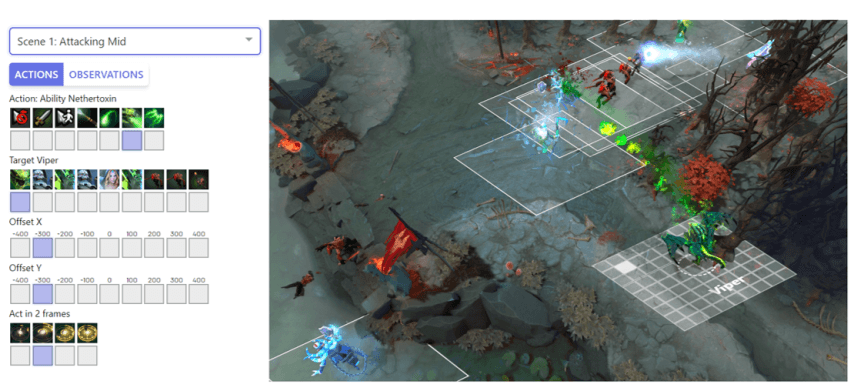 Credit: Medium
The start of OpenAI Five
OpenAI had entered into Dota 2 with an aim of dealing with what seemed like an impossible task using existing deep reinforcement learning algorithms. The project called OpenAI Five was supposed to create an AI capable of competing at professional levels. During this phase they played matches which tested not just its abilities but also showed how much it could revolutionize competitive gaming.
The First Games Against OpenAI
The initial matches of OpenAI in Dota 2 focused on solo duels on Shadow Fiend, which marked a significant step in exploring the capabilities of AI in this complex game. In August 2017, at The International, the largest annual Dota 2 tournament, OpenAI showcased its progress by challenging professional players in 1v1 duels.
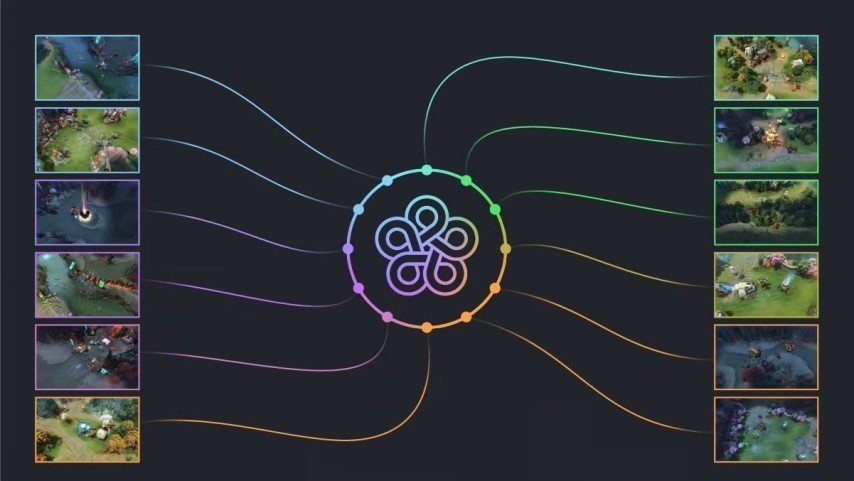 Credit: Nvidia Corporation “AI Learns to Play Dota 2 with Human Precision”
Shadow Fiend, a hero that requires a high level of micro-control and precision, became the perfect platform for testing AI. OpenAI managed to surprise the audience by defeating well-known professionals like Dendi, one of the most famous Dota 2 players, marking an important moment in the history of esports. This was the first time an AI had managed to defeat a professional in such a complex and multifaceted game.
The First Match Against Dendi
At The International 2017, OpenAI challenged Dendi to a duel on Shadow Fiend. The match took place in front of a huge audience, and OpenAI demonstrated the ability to precisely control the hero, execute complex strategies, and make quick decisions. Despite Dendi's experience and skills, OpenAI managed to defeat him by employing well-thought-out strategies and precise resource management.
Historic Victory Against World Champions
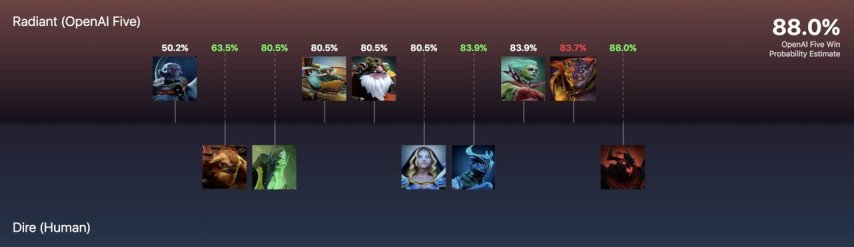
During the Finals on April 15th 2019, openai five made history after beating world champions og twice in a row. It was also streamed live making it the first time any kind of AI had defeated reigning e-sport champs on camera. Beating pros highlighted just how complex these algorithms from openai were as they let ai execute multi-step plans and make decisions faster than humans can react.
 Credit: Techxplore
Public Engagement and Research
Between April 18th and 21st, openai five allowed anyone with internet connection to play against them on dota2’s public matchmaking system. Not only did this serve as another demonstration for their strength (99.4% win rate out of 7,215 games played vs humans) but it also acted as a massive experiment where various types of interactions were studied under different condition while scaling up greatly.
 Credit: Nvidia Corporation “AI Learns to Play Dota 2 with Human Precision”
Technological Innovations and AI Development
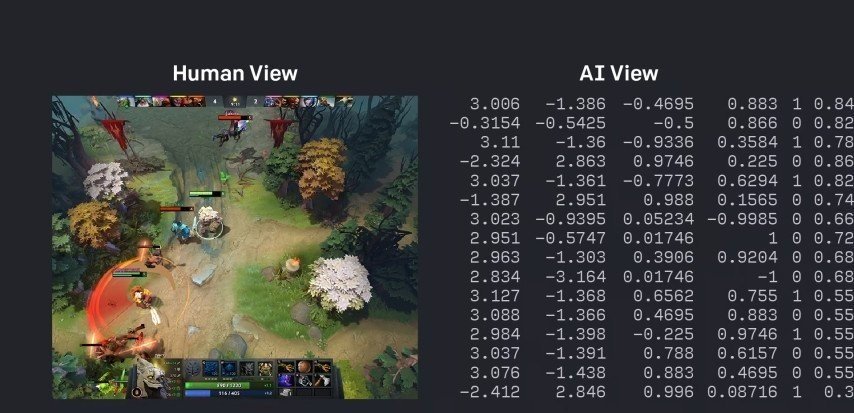
Creating OpenAI Five didn’t come without challenges; In order to scale Proximal Policy Optimization (PPO) algorithms unprecedentedly fast, the team used a system called Rapid. This involved running extensive trainings across many machines: over more than 800 petaflop/s-days of compute were used, simulating 10 months’ worth of Dota gameplay at a rate of about 45,000 years per month to train the AI on how it should make decisions.
Learning and Adaptability
OpenAI Five’s ability to adapt and learn from every game was among its greatest achievements. With frequent updates that often completely changed the dynamics of how Dota2 worked this is quite significant since most other AI’s are unable do so well or even adapt at all when faced with such changes in their environment. The concept “transfer learning” refers to OpenAI Five’s capacity for continued growth through learning which happens despite large-scale shifts within game environment settings being another indication that artificial intelligence could keep evolving as long as there are different situations for it to encounter.
Fresh advancements and AI interaction with Dota 2 and esports
The win records set by Openai five in Dota 2 can be seen beyond mere match victories; It is actually a turning point in understanding what AI can do when placed within dynamic environments with complex rulesets. These findings have potential applications for robotics and automation where machines need make decisions under unpredictable circumstances among others thus this research marks just one more step towards creating advanced forms of artifical intelligent systems.
Following the historical victories of OpenAI Five, the interaction between artificial intelligence and esports continues to evolve. OpenAI is actively expanding the engagement of its AI with Dota 2 players, creating new scenarios for both cooperation and competition. Recently, AI has been used not only for competitive matches but also for cooperative play with humans, showcasing a high level of adaptability to game updates and new strategies.
Additionally, OpenAI launched a public experiment known as OpenAI Five Arena, where anyone can test their skills against the AI or alongside it in cooperative mode. This event received strong support from the Dota 2 community, demonstrating how AI can be integrated into gameplay, enhancing the player experience and pushing the boundaries of what is possible.
A significant step forward has been the integration of OpenAI into educational and research projects, where its successes in complex gaming environments are analyzed. This experience can be applied not only in games but also in other fields requiring real-time decision-making and human-AI collaboration (OpenAI) (Toolify) (KJC Esports).
Conclusion
What OpenAI achieved with Dota2 doesn’t only demonstrate technological capabilities but also indicates future interactions between artificial intelligences and competitive videogaming too. As AIs continue advancing further into human-like behavior territory hybrid teams consisting out both humans & machine components might become common place while new types competitions arise leading us into an exciting era within esports industry itself followed closely behind by other sectors such as business which could greatly benefit from such developments.
This continuing AI expedition in esports is taking the spectators of the world by storm. It shows that blending technology with human skill can create entirely new levels of amusement and rivalry. Using Dota 2 as a foundation, OpenAI has only just scratched the surface for competitive gaming in this age where artificial intelligence meets human resourcefulness to stretch our abilities beyond belief.