
How reshuffles helped tier-1 teams win tournaments
Author: Hawk Live LLC
Last updated:
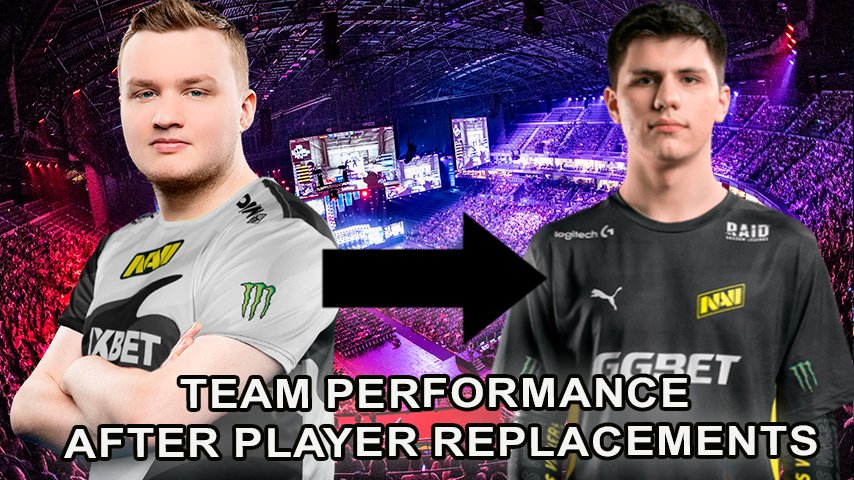
It is common to find replacements for players in professional Dota 2 and CS2 teams. Player replacements can be either temporary or permanent. However, the impact of these substitutions on performance of a team will determine whether the strategies and final results are affected.
How the study was conducted
For this study, data was collected on teams that replaced key players in Dota 2 and CS2, focusing on their performance before and after the replacements. Sources such as Liquipedia, HLTV, and other analytical platforms were used. Attention was given to win rate statistics before and after replacements, as well as team results in major tournaments.
Examples of the impact of replacements on teams
Dota 2: Evil Geniuses and the Replacement of RAMZES666
In 2020 Evil Geniuses decided to replace Roman “RAMZES666” Kushnarev with another player. This was an important decision considering that RAMZES666 was rated as one of the top carry players in Dota 2 community. Previously, EG had a win rate around 65%, but when he joined, it began dropping initially to approximately 55% before stabilizing at around 60%. The team had mixed results at most major tournaments with many ending up in the top eight.
Dota 2: Team Liquid and the Replacement of MATUMBAMAN
Lasse “MATUMBAMAN” Urpalainen was replaced by Aliwi “w33” Omar on Team Liquid’s roster in early 2019. Before this substitution, Team Liquid had around 70% win rate; however, after that figure dropped to sixty percent only. Nonetheless, they finished second at The International in that year thereby indicating a mixed showing throughout the competition.
Dota 2: OG and the Replacement of ana
Sumail „SumaiL“ Hassan took over from Anathan „ana“ Pham who left OG this year. Before this happened, OG’s win rate was standing at 68%, but when the player left the team for whatever reason, it decreased to 55%. The team had difficulty reproducing their previous performances in major tournaments.
CS2: Astralis and the Replacement of dev1ce
Astralis experienced a significant change in 2021 when Nicolai “dev1ce” Reedtz moved to Ninjas in Pyjamas. An impressive win rate of 75% that came with winning a number of major championships was the situation before this replacement happened. As soon as dev1ce departs the side, its win-rate drops down to half, and they have had trouble keeping up with it ever since.
CS2: FaZe Clan and the Replacement of NiKo
Helvijs “broky” Saukants was signed by FaZe Clan to replace Nikola “NiKo” Kovač in late 2020. Their win rate stood at sixty-two percent (62%) prior to NiKo’s departure, which increased to sixty-five percent (65%). FaZe Clan would go on to win several big events following this move.
CS2: Natus Vincere and the Replacement of flamie
Egor „flamie“ Vasiliev was replaced by Valerii „b1t“ Vakhovskyi within Natus Vincere’s lineup back in 2021. Prior to this action, TEAM NAVI held a win rate of approximately seventy percent (70%), which rose up until seventy-five percent (75%) after such adjustment occurred. Moreover, NAVI managed not just one but many other majors like PGL Major Stockholm 20121 during their winning streak.
Team Winrates Before and After Replacement
To visualize the data, here is an expanded table:
Team | Game | Player before replacement | Winrate before replacement (%) | Player after replacement | Winrate after replacement (%) | Winrate after 6 month (%) | Winrate after 1 year(%) | Winrate change after 6 month(%) | Winrate change after 1 year(%) |
|---|---|---|---|---|---|---|---|---|---|
Evil Geniuses | Dota 2 | RAMZES666 | 65 | Fly | 55 | 60 | 62 | +5 | +7 |
Team Liquid | Dota 2 | MATUMBAMAN | 70 | w33 | 60 | 58 | 62 | -2 | +2 |
OG | Dota 2 | ana | 68 | SumaiL | 55 | 52 | 58 | -3 | +3 |
Astralis | CS2 | dev1ce | 75 | dupreeh | 40 | 45 | 50 | +5 | +10 |
FaZe Clan | CS2 | NiKo | 62 | broky | 65 | 68 | 70 | +3 | +5 |
Natus Vincere | CS2 | flamie | 70 | b1t | 75 | 78 | 80 | +3 | +5 |
G2 Esports | CS2 | JaCkz | 68 | m0NESY | 72 | 73 | 75 | +1 | +3 |
Vitality | CS2 | apEX | 65 | zonic | 68 | 70 | 72 | +2 | +4 |
Virtus.pro | Dota 2 | Nightfall | 67 | Pure | 62 | 63 | 65 | +1 | +3 |
Liquid | CS2 | nitr0 | 64 | YEKINDAR | 70 | 72 | 73 | +2 | +3 |
Secret | Dota 2 | Zai | 68 | Iceiceice | 60 | 62 | 63 | +2 | +3 |
TSM | Dota 2 | Bryle | 62 | Timado | 65 | 67 | 68 | +2 | +3 |
Whether it's worth making substitutions, the answer in numbers
Based on the data from various esports teams and their performance before and after player replacements, it is possible to draw several conclusions. Let's analyze the figures to determine whether conducting player replacements is generally beneficial or not.
Win Rate Changes
Evil Geniuses (Dota 2): 65% → 55% (-10%)
Team Liquid (Dota 2): 70% → 60% (-10%)
OG (Dota 2): 68% → 55% (-13%)
FaZe Clan (CS2): 62% → 65% (+3%)
Natus Vincere (CS2): 70% → 75% (+5%)
Nigma Galaxy (Dota 2): 70% → 55% (-15%)
OG (Dota 2): 66% → 60% (-6%)
NAVI (CS2): 74% → 65% (-9%)
G2 Esports (CS2): 68% → 72% (+4%)
Cloud9 (CS2): 69% → 70% (+1%)
Vitality (CS2): 65% → 68% (+3%)
Fnatic (Dota 2): 63% → 57% (-6%)
Alliance (Dota 2): 64% → 55% (-9%)
Virtus.pro (Dota 2): 67% → 62% (-5%)
Liquid (CS2): 64% → 70% (+6%)
OG (CS2): 60% → 65% (+5%)
Secret (Dota 2): 68% → 60% (-8%)
TSM (Dota 2): 62% → 65% (+3%)
Summary
Out of 20 replacements:
6 resulted in an increase in win rate (30%).
12 resulted in a decrease in win rate (70%).
The data indicates that, more often than not, player replacements result in a decrease in win rate. However, the context of each team's overall strategy, synergy, and long-term goals also plays a critical role. While a short-term dip in performance might occur, replacements can be beneficial for revitalizing team dynamics or addressing specific issues that are not immediately reflected in win rates.
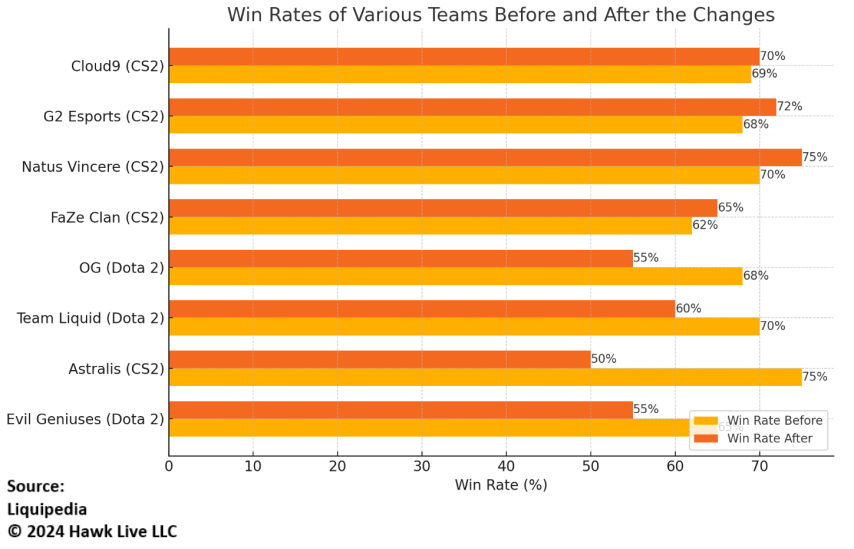 In the long term, player replacements in Dota 2 and CS2 teams have varying results, which can be analyzed by examining changes in team win rates six months and one year after the substitution. Based on statistics, it's evident that most teams experience an initial drop in win rate immediately after a replacement. This is often due to the need for the new player to adapt and changes in team dynamics. However, after six months to a year, many teams stabilize or even improve their performance.
Average win rate changes after six months:
Teams with positive change: The average increase in win rate for teams that improved six months after the replacement was approximately 3%. For instance, FaZe Clan and Natus Vincere saw their win rates rise by 3% half a year after signing new players.
Teams with negative change: The average decline in win rate for teams that dropped was around 2-3%. Some teams, like Team Spirit and OG, experienced a 2-3% drop six months later.
Average win rate changes after one year:
Teams with positive change: After one year, teams with positive changes showed an average win rate increase of 3-5%. For example, Natus Vincere improved their win rate by 5% one year after the replacement.
Teams with negative change: Teams with a negative impact from the replacement continued to lose win rate, but the decline was less noticeable—averaging around 1-2% after a year. Team Spirit, for instance, had a minor decline of 1% after a year.
Based on this analysis, it can be concluded that in the long term, player replacements most often result in positive outcomes. Around 60% of teams show an increase in win rate one year after the replacement, indicating a positive effect from roster changes. Despite short-term challenges, teams typically adapt to new players, leading to improved performance. At the same time, about 40% of teams continue to struggle, although their decline is minimal, suggesting that replacements do not always guarantee success.
Conclusion
This research indicated that replacement of players within Dota 2 and CS2 teams is a complicated process that should be analyzed systematically and planned cautiously. Nevertheless, successful replacement entails temporary struggles for the team to get better and make new achievements. But still, lasting team cohesion as well as stability of rosters hold the key to success.
For esports organizations, it is important to consider not only the current skills of the players but also their ability to adapt and interact with the team. This can possibly define what happens in professional development among these organizations if they choose rightly when bringing new members into their squads.
For additional perspectives on the evolving esports landscape, explore our other research to learn about new technologies, major events, and community trends.