
How NFTs are changing modern business
Author: Hawk Live LLC
Last updated:

In 2021, NFTs became one of the most discussed technologies not only in the cryptocurrency market, but in all IT. The user learned about collectibles, digital art and Play to Earn games, and the value of this sector according to Chainalysis was more than $44 billion.
But all the talks around the sector are focused primarily on the experience of private users. We will consider how NFTs can be used for business and its development, and what experience of interaction with them international companies have.
Strategies for integrating NFT into business
According to the research from the Hotspot blog, 14% of the surveyed media planners used NFTs in their work in 2022. If we study the experience of different companies, including large ones, which one way or another resorted to non-fungible tokens, we can assume that this figure is actually even higher, but may fluctuate depending on the situation on the cryptocurrency market.
Either way, there are multiple ways for brands to use NFT to engage their audience – as an autonomous, stand-alone product, or as an audience engagement tool for other purposes.
NFT as an autonomous product
The specificity of NFTs allows them to be used as a separate product that complements the main product range of the company. Branded tokens can be created based on a logo, a popular or iconic product, sold just for fun or in honor of iconic events and help to solve the following tasks:
- To attract the attention of the audience, perhaps to interest new groups of consumers who were not previously its customers;
- Get additional profit.
One of the brands that decided to integrate trending technology into their business was Nike. In April 2022, the company released a collection of NFT sneakers called Cryptokicks, which consisted of 20,000 objects - later The New York Times reported that one of the virtual pairs was sold for $134,000. In total, the brand earned about $185 million from projects related to non-fungible tokens.
Engagement Tool
Over the past 20 years, advertising and promotion have experienced two global transformations.
The first is after the transition from Web 1.0 to Web 2.0, which took place around 2004. The first generation Internet did not provide the user with any models for interacting with content other than consuming it, and had a limited number of tools for creating and filling pages.
The Internet of the Web 2.0 generation not only allowed users to interact with content and provided accessible methods for creating it, but also opened up the potential of online advertising. Search engines began to integrate monetization tools, the first advertising networks appeared, offering businesses previously unknown formats for promoting goods and services.
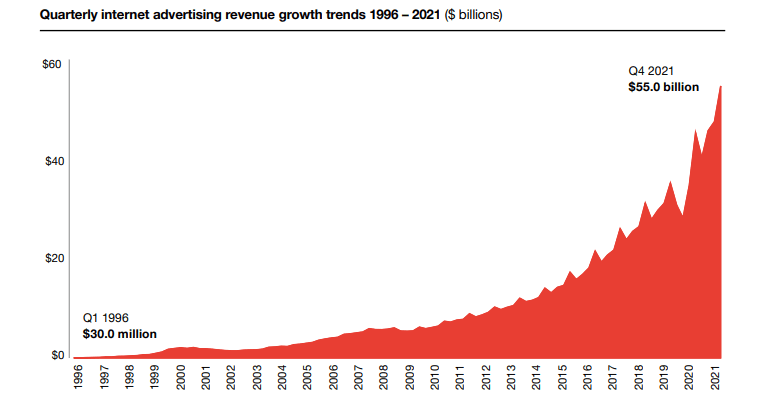
The second transformation coincided with the popularization of social networks. We studied the statistics from the IAB / PwC Internet Ad Revenue Report from 2021:
Source: IAB / PwC Internet Ad Revenue Report, 2021
The graph clearly demonstrates that between 2005 and 2010 the size of the online advertising market remained relatively stable and did not change much or changed little. In 2010, the social network Instagram appeared on the market, and Facebook, which existed since 2004, began to rapidly gain an audience - in 2010, the annual increase in unique users was 38%. Twitter, created in 2006, achieved even more impressive results in 2010: the annual increase in the audience was more than 200%.
The growth of the audience is fully correlated with the growth in the volume of advertising, which thus received a tangible impetus to development.
Cryptocurrencies, NFTs and blockchain could be the third revolutionary wave for e-commerce, herewith, the role of social networks will not decrease. At the end of 2021, Coindesk published an article stating that cryptocurrencies in general and non-fungible tokens in particular form a community around them, concentrated in social networks (especially anonymous ones), and brands can use this to their advantage.
The main thing from the article is: the entire audience that companies attract on Discord or Twitter is not just a one-time base for holding promotions or short-term sales. The more actively a brand gathers a community around itself now, the easier it will be to identify it as a target and incline to brand initiatives in the future, according to Coindesk.
Burger King was one of the first to understand this concept and started using it to shape their community. In 2021, the company launched a promotion connected, though not with NFTs, but with classic fungible currencies - Bitcoin, Ethereum or Dogecoin - that could be obtained by placing an order in the application in the amount of $5.
This is how, by holding special promotions or organizing events, but with NFTs, additional involvement can be achieved.
NFT and marketing
A marketing funnel is a step-by-step process of making a decision to buy a product or service. It starts with attracting attention at the first acquaintance with the brand and ends with the completion of a targeted action.
NFTs can be used at every stage of the marketing funnel as an advertising tool to push the user to buy. It looks like this:
- Acquaintance. Increase brand awareness, reach new audience segments through the use of NFTs, and create more personalized advertising strategies.
- Purchase. Increase the competitiveness of the main product through the use of NFTs as a unique advantage or a pleasant bonus to purchase.
- After purchase. Consolidate a positive brand experience after purchase by transferring ownership of an exclusive object or giving token holders the right to receive a new collection of NFTs.
In addition, non-fungible tokens are an important element of brand identity and story. In the near future, this marketing tool may become completely indispensable: society is on the verge of a transition to Web 3.0 with new formats of social interaction and business.
NFTs and advertising
We have selected several companies from different niches that have successfully implemented NFTs into their marketing strategy and used for this different formats.
The first current example is the beverage company Anheuser-Busch, which owns the brands Budweiser, Stella Artois, Corona, Leffe, Hoegaarden and others. In March 2022, it held a promotion related to non-fungible tokens.
Users who previously purchased NFT Budweiser were able to take part in the NFTBeerFest held at one of the company’s breweries. Anheuser-Busch used the previously mentioned Twitter and Discord to promote this project.
The second example is the use of NFTs as a standalone product. The Coca-Cola Company decided to skip events and instead launched its own NFT collection in 2021. The tokens sold at the auction brought in $575,883.61.
The auction took place on the NFT marketplace OpenSea, and the entire collection was sold out in 72 hours.
Finally, the third example of using NFT to interact with the audience on social platforms is the McDonald’s promotion, launched on November 1, 2021. The company promised users an exclusive token created in honour of the 40th anniversary of the McRib sandwich and its temporary return to the restaurant menu in some countries. All that had to be done to get it was to repost a tweet posted on the official account.
The publication collected more than 2 million views and 82 thousand retweets. The winner got his NFT, and McDonald's got an influx of audience and a portion of attention.
Brand representation in metaverses and games
Metaverses, virtual reality and P2E games are an integral part of Web 3.0. The properties of NFTs, namely the uniqueness, authenticity and transparency of ownership, make them an ideal tool for digital ownership: land, clothing, accessories or real estate.
As the popularity of the metaverses and games is growing, so will the demand for various digital objects needed to customize avatars or enhance the gameplay. This opens up unlimited space for brands to work. And not only selling goods, but also offering various services: for example, fitness centers or yoga clubs can conduct virtual distance classes and thus earn money.
However, so far, it is the manufacturing companies that have been noted most of all in the metaverses.
Gucci
The Gucci fashion house launched several NFT projects in 2021 and 2022. One of them is in the Roblox gaming metaverse, where the company organized a two-week exhibition space and its own boutique, where you can get virtual accessories for avatars.
Subsequently, in May 2022, the appearance in Roblox of a whole settlement dedicated to the brand, in which the company repeated the idea with a boutique selling NFTs for avatars, became known to the general public.
Finally, Gucci has partnered with the 10KTF NFT project to launch a token called Gucci Grail, a unique collection of famous avatars from other collections dressed in branded outfits. It was extremely difficult to get access to these tokens: the company formulated a number of requirements, such as:
- Registration and obtaining a special “Mint pass” (limited offer - 5,000 passes);
- Owning NFTs from previous collections and paying a fee of 1 ETH;
- Active participation in the life of the Discord community and others.
This is a clear example of a strategy to engage and encourage brand affinity, and the way Gucci emphasized the exclusivity of their NFTs.
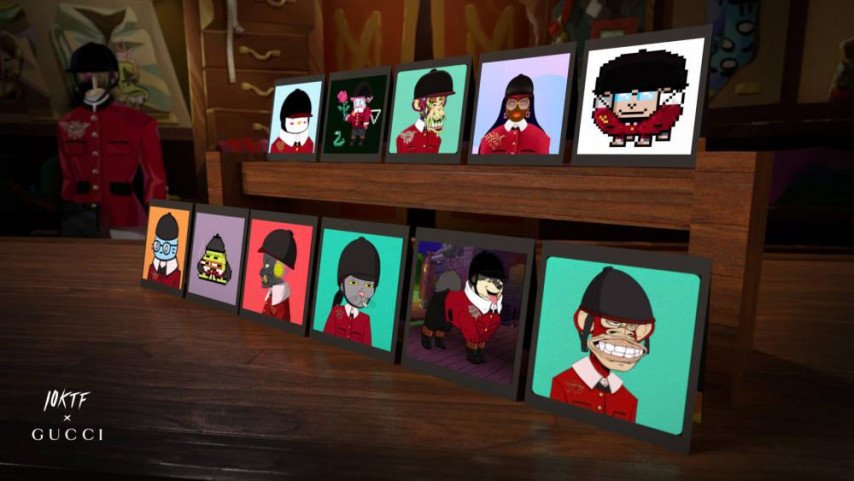
NFT Gucci x 10KTF
Nike
We have already mentioned that Nike released their own collection of NFT sneakers. But this is not the company’s only interaction with the non-fungible token sector.
In November 2022, The Verge published an article that Nike was launching its own Web 3.0 platform, Swoosh, which was in closed beta testing at the time of this writing. The new community is designed exclusively for the metaverses and NFTs, where users will be able to “sell, buy and trade virtual clothes and shoes”.
The .Swoosh website says that items purchased here can be used in the metaverse and GameFi - the specific names of the projects were not specified. The publication of the first collection is scheduled for the first quarter of 2023.
Like Gucci, the company did not miss the opportunity to join the already existing metaverses. In 2021, Nike opened the Nikeland space, which was visited by about 7 million users in less than a year. In addition to events organized in the Nikeland virtual world, users can purchase digital accessories for their avatars.
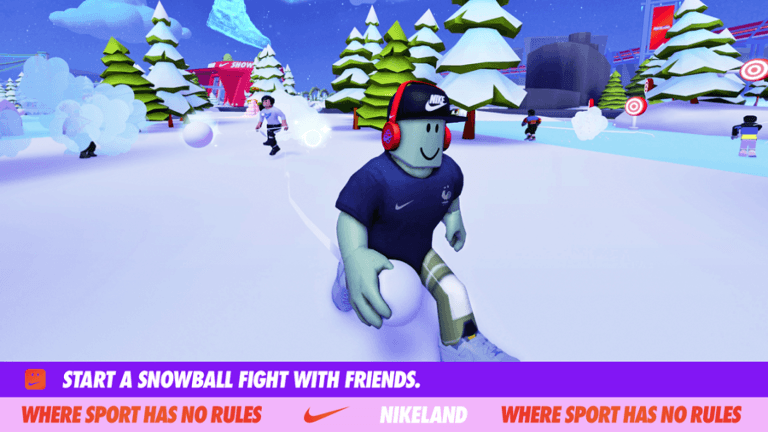
Avatar dressing NIke accessories
Adidas
Adidas also showed interest in the metaverse and presented to the audience a collection of outerwear for the virtual world.
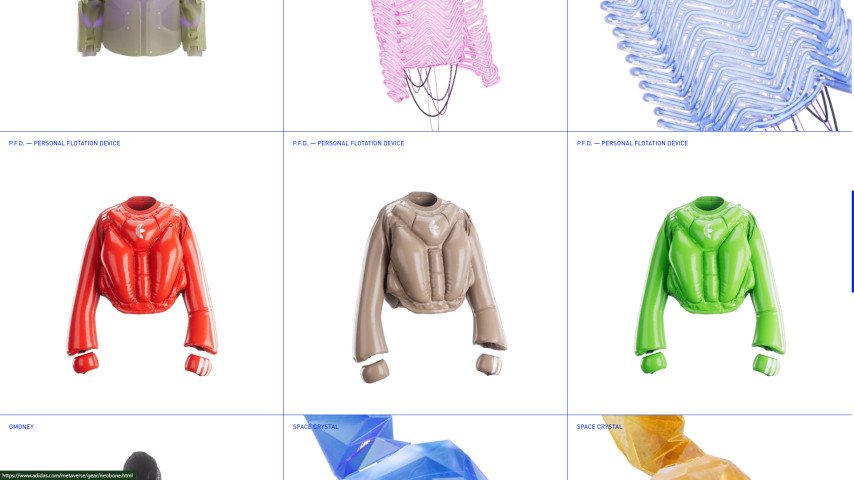
NFT Collection by Adidas
Collectibles can be bought at the OpenSea auction, on the official Adidas page. Before that, in 2021, the company bought several digital lots in The Sandbox metaverse.
Why Businesses Use NFTs
The answer to this question may seem obvious: businesses use NFTs because they are in trend. In fact, the reasons for this phenomenon are deeper.
Variety of formats
The first factor is the large number of formats in which brands can implement their NFTs. In addition to classic avatars like CryptoPunks or Bored Ape, non-fungible tokens come in the form of animations, 3D models, and even MP3s. This opens up the potential for testing the performance and marketability of different tokens.
Cost reduction
Companies that have chosen NFT as a standalone product to generate additional profits significantly reduce the costs of production, logistics and storage, as well as returns in case of a defect.
Personalized experience
Unlike other, more traditional marketing methods, NFTs are able to provide a more personalized experience to the customer, and personalized experiences are always better remembered due to the feeling of exclusivity.
Increasing loyalty and recognition
Finally, last but not least, point is to increase brand loyalty, which allows to effectively withstand market competition. Following current trends, building a new community and trusting relationships with it, providing new products and services related to NFT, in the future, can help build a long-term connection with the audience and enlist its support.
Conclusions
We are coming to the key question of this article: How do non-fungible tokens change business? The answer is simple: they allow it to earn more. NFT is about entering new markets and new audiences, creating new product groups and testing new marketing tools.
That is why we can assume that the involvement of brands in the Web 3.0 niche and cryptocurrencies will be growing in 2023.