
Dota 2 team income and cost of maintenance analysis
Author: Hawk Live LLC
Last updated:
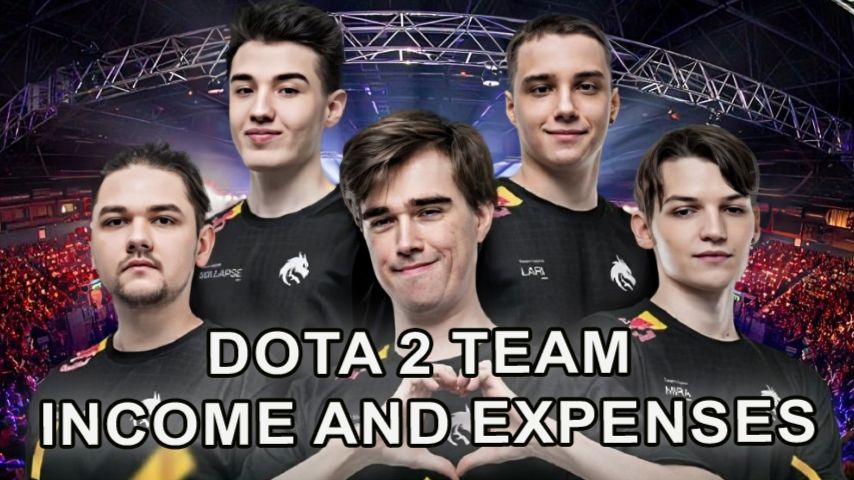
As one of the most followed cyber sports discipline, the audience that consumes content from popular teams is massive, meaning that the prize money is usually quite high, and almost always profitable for Esports teams. However, keeping a Dota 2 lineup requires a lot of investment as well. In this article, we will analyze how much a Dota 2 team can earn and how much it costs to maintain the team as a function of its results.
How much does it cost to maintain a Dota 2 tier 1 team?
Dota 2 Tier-1 teams are made up of the best cybersports players in the area. Such teams compete in the biggest tournaments, having the maximum potential for successful earnings, however, the costs of such a cyber sports organization are also quite high. They include not only players' salaries, but also coaching staff and analysts, organization of training process and travel. Marketing expenses and content creation to attract the attention of the audience also make up a significant part of the organization's budget.
According to the estimates of Afkgaming publishing, citing the heads of cyber sports clubs in Southeast Asia, to launch a Dota 2 team that can claim victory in Tier-1 tournaments, organizations need to invest from $300,000 to $500,000 in the first year of operation. At the same time, he estimates the cost of salaries for players, coaches and analysts at 1 - 10 thousand dollars per month. Nevertheless, players and coaching staff of the teams, which actively win at the tier-1 tournaments, receive up to 10 - 15 thousand dollars a month, and even more, however, this increase comes from the income of the club at the expense of prize money. According to a recent statement by the famous pro-player Artem “Fng” Barshak, the salary in such teams as  Team Spirit,
  Gaimin Gladiators and
  Team Falcons , and can reach 20 thousand dollars a month.
Minimum operating costs, which include labor costs for the rest of the staff, including SMM, marketers and lawyers team owners estimate from 4 to 5 thousand dollars per month, and this amount increases greatly if the team starts to actively participate in international tournaments, reaching 100 thousand dollars.
The cost of renting a bootcamp is estimated at about 5 - 6 thousand dollars per month, but this amount strongly depends on the conditions and geolocation. As an alternative, some teams rent comfortable living quarters, which reduces regular expenses, but in this situation the organization has to buy computers and network equipment, which requires considerable investment.
Not all organizations sign famous streamers to expand their fan base, but their contracts can also reach $8,000 - $10,000 per month if they have a large fan base.
CEO of  Evil Geniuses Nicole LaPointe Jameson, although he didn't name the exact amount of the teams' expenses, confirmed in TheVerge podcast that the Dota 2 tier 1 team's activities require millions of dollars of investment.
Tournament costs are highly dependent on the format of the event. While a team bootcamp is enough to participate in online tournaments and qualifications for Lan events, traveling to major championships is quite expensive, taking up a significant part of the team's budget.
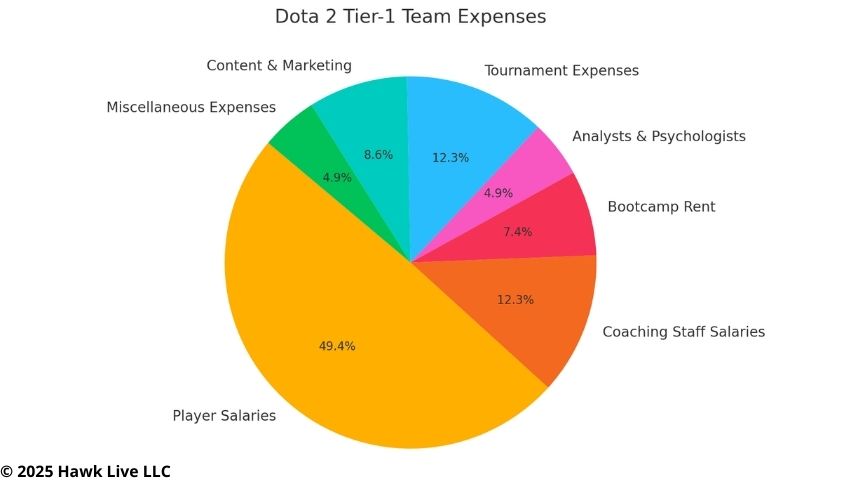
Estimation of expenses of a tier-1 team:
Expenditure item | Estimate (min - max) |
|---|---|
Player salaries | $500,000 - $1,500,000 |
Salaries of coaching staff | $100,000 - $400,000 |
Bootcamp Rentals | $50,000 - $250,000 |
Analysts and psychologists | $50,000 - $150,000 |
Tournament Expenses | $100,000 - $400,000 |
Content and marketing | $50,000 - $300,000 |
Other expenses | $50,000 - $150,000 |
Total | $900,000 - $3,150,000 |
Thus, it costs in the range of $900,000 - $3,150,000 per year to maintain a Tier-1 team. In some cases the costs may be higher, for example, if the team actively participates in international tournaments or spends more on marketing.
Income of Dota 2 tier-1 team owners
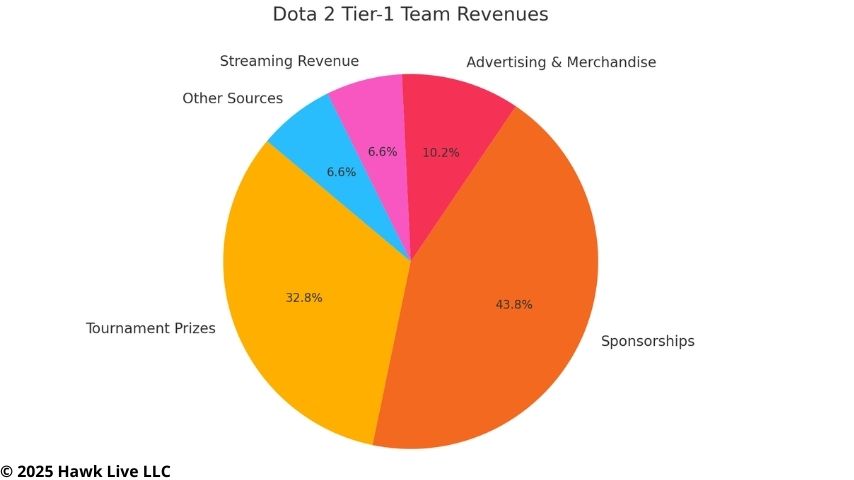
According to information provided by LaPointe, as well as Esports Insider publishers, but not the main source of income for a Dota 2 tier 1 team. Most of the money comes from sponsorship contracts, advertising, selling club merch and streaming. Sponsorships are considered the largest source of income, but prize money also accounts for 20% to 40% of total income. Such teams often receive financial support from betting companies, and thanks to the vast audience of fans, the amount of revenue can reach impressive proportions.
According to BBC News, Johan “N0tail” Sundstein has been recognized as the richest player in Dota 2 history, collecting more than $7.4 million in prize money. His team,  OG, is the richest cybersport organization in the direction of Dota 2 with a total budget of about 33.5 million dollars. With this money the player bought a 17-room villa, creating in it all the conditions for comfortable gaming. On this the player spent more than 1.8 million dollars.
Tier-1 team revenue breakdown:
Source of revenue | Estimate (min - max) |
|---|---|
Tournament prize money | $500,000 - $4,000,000 |
Sponsorship contracts | $1,000,000 - $5,000,000 |
Advertising and merchandising | $200,000 - $1,200,000 |
Streaming revenue | $100,000 - $800,000 |
Other sources | $100,000 - $800,000 |
Total | $1,900,000 - $11,800,000 |
Thus, a tier-1 team can earn between $1,900,000 and $11,800,000 per year. If you subtract expenses, profits can range from $1,000,000 to $8,650,000. In rare cases, top clubs can earn even more through large sponsorship contracts and regular top positions in major tournaments.
How much does it cost to run a tier-2 Dota team?
D2 teams are less stable, and their roster consists of both promising young players and pro stars who are going through some rough patches in their careers. Nevertheless, if a club performs well on the Dota 2 scene and also sometimes qualifies for Dota 1 events, the costs of running the team will be lower but still require a significant financial investment.
Salaries of players at the stage of team formation can be hundreds of dollars, but if the team regularly wins at tier-2 tournaments, its members will start to receive 1.5 - 2 thousand dollars a month. At the same time, if the team claims to be actively developing, the coaching staff and analysts will have to pay at least 1 - 2 thousand dollars at once. The organization of a bootcamp is still a big enough share of expenses, but some teams refuse from it at all, preferring online training, or pay for the room short-term for tournaments.
Estimated costs of a tier-2 team:
Cost item | Estimate (min - max) |
|---|---|
Player salaries | $100,000 - $400,000 |
Coaches' salaries | $50,000 - $120,000 |
Bootcamp rent | $20,000 - $80,000 |
Tournament expenses | $50,000 - $150,000 |
Other expenses | $30,000 - $120,000 |
Total | $250,000 - $870,000 |
Expenses for tier-2 teams are highly dependent on the frequency of travel to tournaments and investment in training. You can put together a lineup that can make a name for itself on the tier-2 scene with much less investment than a tier-1 team.
Income of tier-2 club owners
Such teams sometimes get into tier-1 events in case of winning regional qualifications, and can also get good prize money in case of winning tier-2 events. Nevertheless, the income from such a team is much lower, because the audience's interest in tier-2 events is much inferior to watching prestigious tournaments. Moreover, if a team manages to get to the tier-1 event, such teams rarely get decent places with big prize money, which should also be taken into account when evaluating them.
Table of income of a Tier-2 team:
Source of income | Evaluation (min - max) |
|---|---|
Tournament prize money | $50,000 - $700,000 |
Sponsorship contracts | $200,000 - $1,200,000 |
Advertising and merchandise | $50,000 - $250,000 |
Streaming | $30,000 - $150,000 |
Total | $330,000 - $2,300,000 |
There are cases when tier-2 teams make several tens of thousands of dollars in losses per year, but the potential profit of such a team can be $70,000 to $1,430,000. In some cases, successful tier-2 teams get lucrative sponsorship contracts, which significantly increases their income.
How much does it cost to run a Dota 2 tier-3 team?
Dota 2 tier-3 teams are small teams, often consisting of promising players who are only aspiring to conquer the professional Dota 2 scene. Sometimes such teams are formed on the enthusiasm of the players themselves, but still the activity of the club requires certain investments. According to Roman “RAMZES666” Kushnarev, his earnings at the beginning of his career as a member of ScaryFaceZ were 250 - 300 dollars.
Estimating the costs of a tier-3 team:
Cost item | Estimate (min - max) |
|---|---|
Player salaries | $10,000 - $50,000 |
Bootcamp Rental | $5,000 - $30,000 |
Tournament Expenses | $5,000 - $40,000 |
Other Expenses | $10,000 - $50,000 |
Total | $30,000 - $170,000 |
Cut your expenses to virtually nothing by joining only online events and training remotely. If the club is self-organized by the players and is not associated with a particular organization, salary costs can also be omitted.
Tier-3 team income
Profits from participating in tier-3 tournaments are often insignificant, but in case of regular success can cover the minimum expenses of the team. Due to the small fan base, the income from advertising and sponsorship contracts will also be small, but still the club can make some profit in the budget.
Estimated income of the tier-3 team:
Source of income | Estimate (min - max) |
|---|---|
Prize money | $5,000 - $50,000 |
Sponsorship contracts | $10,000 - $100,000 |
Streaming and advertising | $5,000 - $40,000 |
Total | $20,000 - $190,000 |
Since these cyber sports organizations are often formed with the prospect of succeeding in the Dota 2 tier-2 and even Dota 2 tier-1 pro scene in the future, these teams often operate on the brink of breaking even or even at a loss, but can still generate tens of thousands of dollars in profit per year.
Dota 2 team income and expenses distribution
Based on the estimation of income and expenses of Dota 2 teams, we can make distribution charts to analyze the main expenses and sources of replenishment of the budget of a cyber sports organization. Analyzing the expenses we can see that most of the expenses are spent on paying salaries to the staff and the team. Also a very important part of the expenses is the organization of bootcamp and travel to tournaments.
The income of the teams, first of all, consists of sponsorship payments, which most often are bookmaker companies, but the prize money is also an important part of the income. It is worth noting that although streaming and content creation do not bring much income to organizations, they expand the fan base and form the image of a cyber sports club.
How the income of a Esports club depends on the results of the Dota 2 roster
The chart below shows that the biggest earning potential is for T1 teams, but T2 clubs can also expect a good income in case of good results, media exposure and competent management. However, tier-3 teams can't claim high revenues, but can only recoup their work by making a small profit.
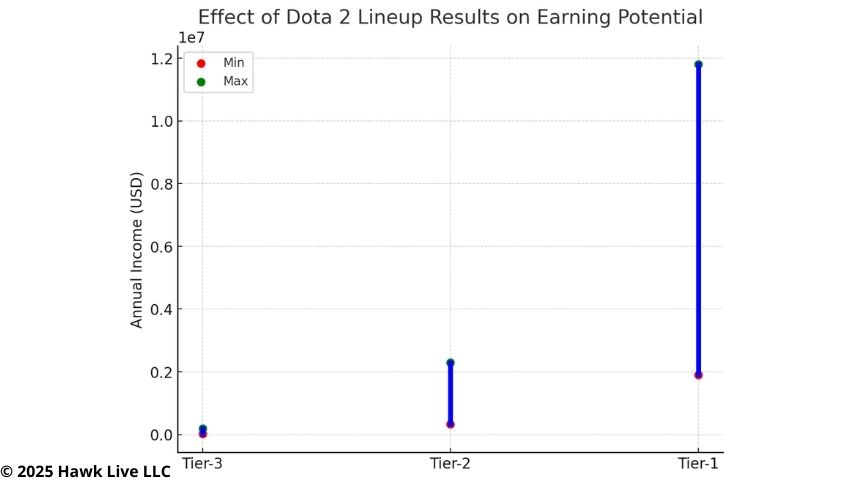
It is also worth noting that tier-1 clubs are able to bring quite high revenues, but for this team must not only consistently show high results, but also to conclude favorable advertising contracts, as well as actively develop media presence, expanding the audience of fans.
How to build a professional Dota 2 team
Building a professional Dota 2 team is a complex process that requires both financial investment and a strategic approach. There are two main ways:
Investing in professionals. This is the most costly option for already operating cyber sports organizations, but it gives quick results. Buying a ready-made roster or attracting strong players through contracts allows a team to immediately compete for a place on the Dash-1 scene. However, it requires serious financial investments for salaries, bootcamps and training.
Looking for a promising set of players to fill the roster? You may proceed by building the team from scratch, but this approach is often time intensive as the team will need to take part in open qualifiers and improve on their own. The up side is that good teams tend to get picked up by larger organizations when they showcase great results at tournaments or when they excel as the leaders of the pro scene. These organizations allow the teams to retain their uniqueness.
Both options do have their positives and negatives. Consideration of the resources available to the cyber sports club seeking to develop this new marketing strategy are key. Most well known eSports organizations, with the exception of the teams signed by betting companies, are usually owned by founders who were once players in the initial squads.
Conclusion
A Dota 2 team can generate a significant amount of profit, but it still requires a significant investment to maintain the club as well. The profitability of the organization, as well as the amount of expenses directly depends on the results. Nevertheless, successful tier-1 clubs can generate large revenues through regular participation in major events, which forms a significant financial potential for further development of the team.